Politics
“ABAHAMBE MUST CONTINUE”: KENNY KUNENE DEFENDS PA’S HARD-LINE IMMIGRATION MESSAGE
The PA says it is putting South Africans first. But when immigration becomes political currency, the question is not only who must leave — it is who is being seen, heard and counted as a South African in the first place.
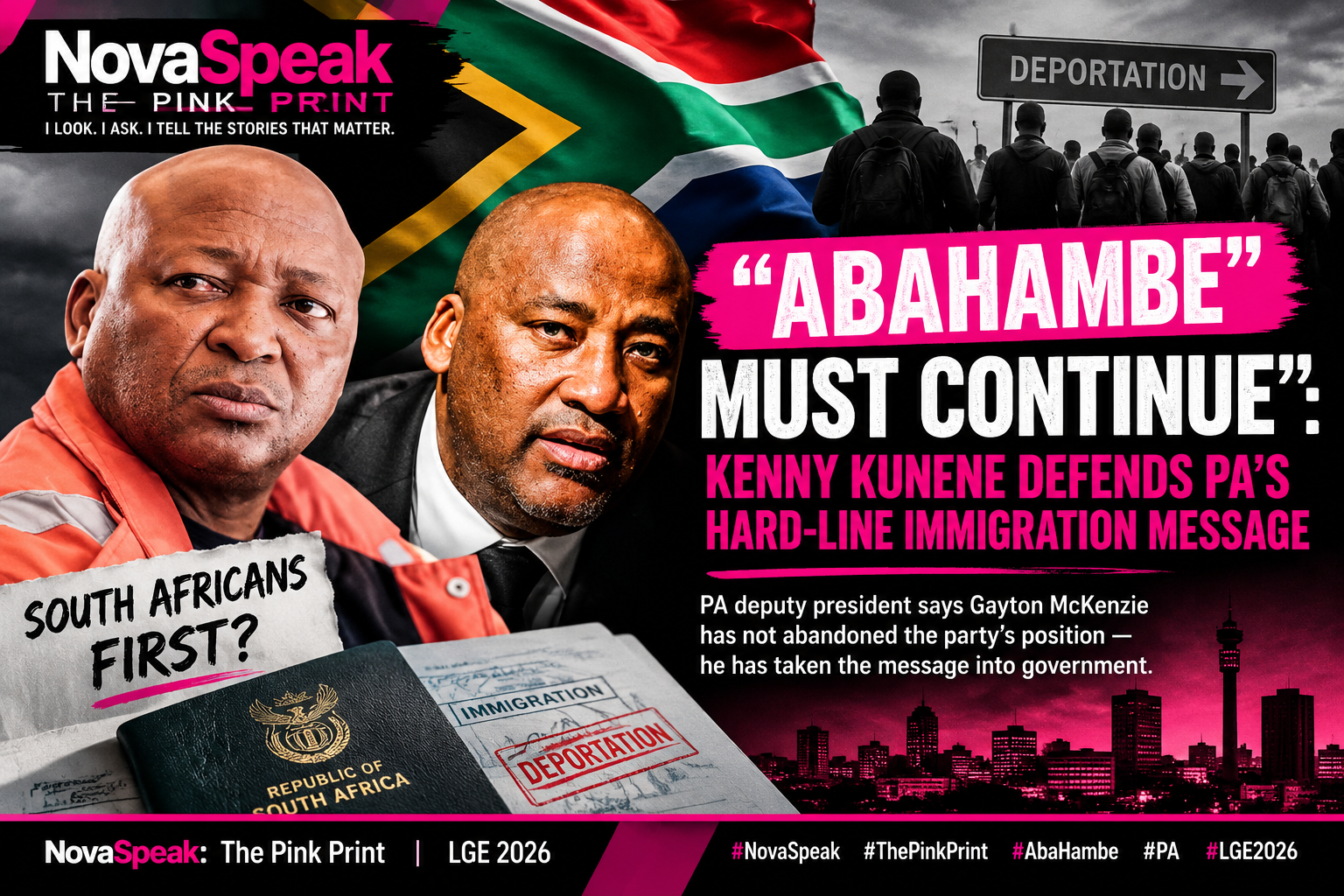
BLOEMFONTEIN — The Patriotic Alliance does not appear to be backing away from its hard-line immigration message. If anything, Deputy President Kenny Kunene's latest defence suggests that “Aba Hambe” remains firmly embedded in the party's political DNA — even as party leader Gayton McKenzie now occupies a seat inside the very government whose immigration policies the PA once attacked from the outside.
But beneath the slogan sits a more uncomfortable question for South Africa: when politicians promise to put “South Africans first”, which South Africans are actually being seen, heard and prioritised?
That question matters particularly in communities where political parties routinely speak about unemployment, poverty, housing, crime and failing services, yet where citizens can feel politically visible only when their votes are needed.
Kunene, speaking ahead of the PA's 2026 Local Government Elections manifesto launch in Bloemfontein, was unequivocal: McKenzie has not abandoned the party's position on illegal immigration simply because he is now a Cabinet minister.
The difference, Kunene argued, is one of political position.
McKenzie, as a government minister, operates within the responsibilities and constraints of the executive. McKenzie, as PA leader, remains free to articulate the party's political position.
And that position, Kunene made clear, remains:
“Aba Hambe.”
The phrase — broadly translated as “they must leave” — has become one of the PA's most recognisable political messages around undocumented migration. SABC News reported on 26 September that Kunene said the party remained focused on service delivery, employment and combating irregular migration.
The slogan is not new.
The PA previously used “Aba Hambe” as the theme of its anniversary event in 2023 while reiterating its call for the mass deportation of undocumented foreign nationals.
Its 2024 manifesto went further, listing “Zero Tolerance for Illegal Immigration” as the party's second major policy point and committing a PA government to sending illegal migrants home, strengthening immigration enforcement and pursuing mass deportations.
The party also proposed tougher consequences for businesses employing undocumented workers and greater powers for immigration authorities.
So Kunene's defence cannot easily be dismissed as election-season improvisation.
The policy position exists.
The slogan exists.
And the political constituency behind it exists.
The more difficult question is what happens when campaign language meets the machinery of government.
THE MESSAGE HAS ENTERED GOVERNMENT
The PA is no longer simply shouting from outside the executive.
McKenzie is inside it.
That changes the stakes.
Kunene's argument is essentially that the PA has not surrendered its immigration agenda by entering government. Instead, it has taken the fight into government.
He pointed to President Cyril Ramaphosa's 2026 State of the Nation Address and the announcement concerning additional labour inspectors as evidence, in his view, that issues around immigration enforcement and employment are receiving greater attention.
The PA's manifesto launch messaging also placed illegal immigration alongside water, electricity and jobs — issues that have direct consequences for communities already struggling with unemployment and failing municipal services.
And therein lies the political calculation.
Immigration is not being discussed in isolation.
It is being linked to jobs.
It is being linked to public services.
It is being linked to housing.
It is being linked to the question of who gets access to scarce opportunities in a country where millions of South Africans remain economically excluded.
That makes the PA's message politically powerful.
But it also makes the language particularly important.
“ILLEGAL” IS A LEGAL STATUS. “FOREIGNER” IS NOT.
There is a distinction South Africa cannot afford to lose in the noise of political campaigning.
A person who is undocumented or unlawfully present in the country may be subject to immigration enforcement in terms of the law.
But “foreigner” is not synonymous with “illegal immigrant”.
Nor is every foreign national undocumented.
That distinction matters because political slogans can travel further than the policies from which they originate.
The PA's formal policy refers to illegal immigration and immigration enforcement. But a slogan such as “Aba Hambe” can be heard beyond that narrower legal category, particularly in communities where frustration over unemployment, crime and pressure on public services is already high.
That is where political rhetoric meets social reality.
And it is where the PA should expect difficult questions.
Who exactly must leave?
On what legal basis?
Who determines their immigration status?
What due process applies?
What happens when a person has a valid permit?
What happens to asylum seekers?
What happens to families with mixed immigration statuses?
What safeguards prevent lawful migrants from being swept into enforcement operations?
And how does government enforce the law without turning nationality itself into a proxy for criminality?
These are not technical questions.
They are the difference between immigration enforcement and political scapegoating.
BUT THERE IS ANOTHER SOUTH AFRICAN STORY
There is also a deeper political problem hiding behind the immigration debate.
South Africa's political conversation increasingly revolves around competing claims over who has been excluded, who deserves opportunity and who has been left behind.
Yet some communities remain caught between these narratives.
The Coloured South African, for example, can find themselves politically visible during elections and historically acknowledged during discussions about apartheid, but less visible when political parties construct their national narratives around a Black-versus-White framework.
That political invisibility cannot simply be ignored.
A Coloured resident facing unemployment does not experience the jobs crisis differently because politicians have failed to properly articulate where Coloured communities fit into the national economic story.
A young person in a township or historically marginalised community does not pay rent with political rhetoric.
They need work.
They need functioning schools.
They need safe streets.
They need reliable electricity and water.
They need housing.
They need an economy in which their surname, neighbourhood or racial classification does not determine whether their application reaches the top of the pile.
This is why the PA's “South Africans first” message deserves to be interrogated beyond the immigration debate.
First in what?
First to jobs?
First to housing?
First to public services?
First to government contracts?
First to political attention?
And if South Africans are supposed to come first, which South Africans have historically been left waiting?
Those questions become particularly relevant ahead of the 4 November 2026 Local Government Elections.
Because local government is where political promises eventually encounter potholes, water outages, electricity failures, housing queues, unemployment and neighbourhood safety.
It is also where voters have to decide whether a party's national rhetoric translates into tangible local government performance.
THE PA HAS MADE ITS POSITION CLEAR. NOW COME THE HARD QUESTIONS.
Kunene's message removes much of the ambiguity.
The PA has not abandoned “Aba Hambe”.
McKenzie's move into Cabinet has not erased the party's hard-line immigration position.
The PA says it remains committed to putting South Africans first and tackling illegal immigration.
But government is not a campaign stage.
It is where slogans have to become policy, policy has to survive constitutional scrutiny, and enforcement has to operate within the law.
That is where the PA's real test begins.
Because it is one thing to say “Aba Hambe” to an angry crowd.
It is another to stand inside government and explain exactly who must go, why they must go, how the law will be applied, and what happens to those who have a lawful right to remain.
And perhaps there is an even bigger question.
If the PA succeeds in making immigration one of the defining issues of the 2026 election, what happens to the South African who is neither politically powerful nor part of the loudest racial or ideological constituency?
What happens to the unemployed Coloured graduate?
The township entrepreneur?
The young person who has never had a permanent job?
The family waiting years for housing?
The resident whose municipality cannot provide basic services?
Do they become the political centre of the “South Africans first” promise — or merely another audience being asked to choose a side?
That is the uncomfortable test facing the PA.
Because South Africa does need an honest conversation about illegal immigration.
It needs effective border management.
It needs lawful enforcement.
It needs action against employers who exploit undocumented workers.
And it needs an economy capable of creating opportunities for citizens.
But none of those objectives requires South Africa to abandon precision, legality or human dignity.
And if “South Africans first” is going to be more than a campaign slogan, then the PA must answer a question far more difficult than “Who must leave?”
It must explain who, exactly, it intends to make sure is no longer left behind.
NovaSpeak: The Pink Print
WE LOOK. WE ASK. WE TELL THE STORIES THAT MATTER.
#NovaSpeak #ThePinkPrint #KennyKunene #GaytonMcKenzie #PatrioticAlliance #PA #AbaHambe #LGE2026 #IllegalImmigration #Immigration #SouthAfrica #Bloemfontein #Politics #LocalGovernmentElections