Investigations
HEIDEDAL’S DETERIORATING INFRASTRUCTURE: HOW OLD ARE THE PIPES BENEATH OUR STREETS?
HOW OLD ARE THE PIPES BENEATH OUR STREETS?
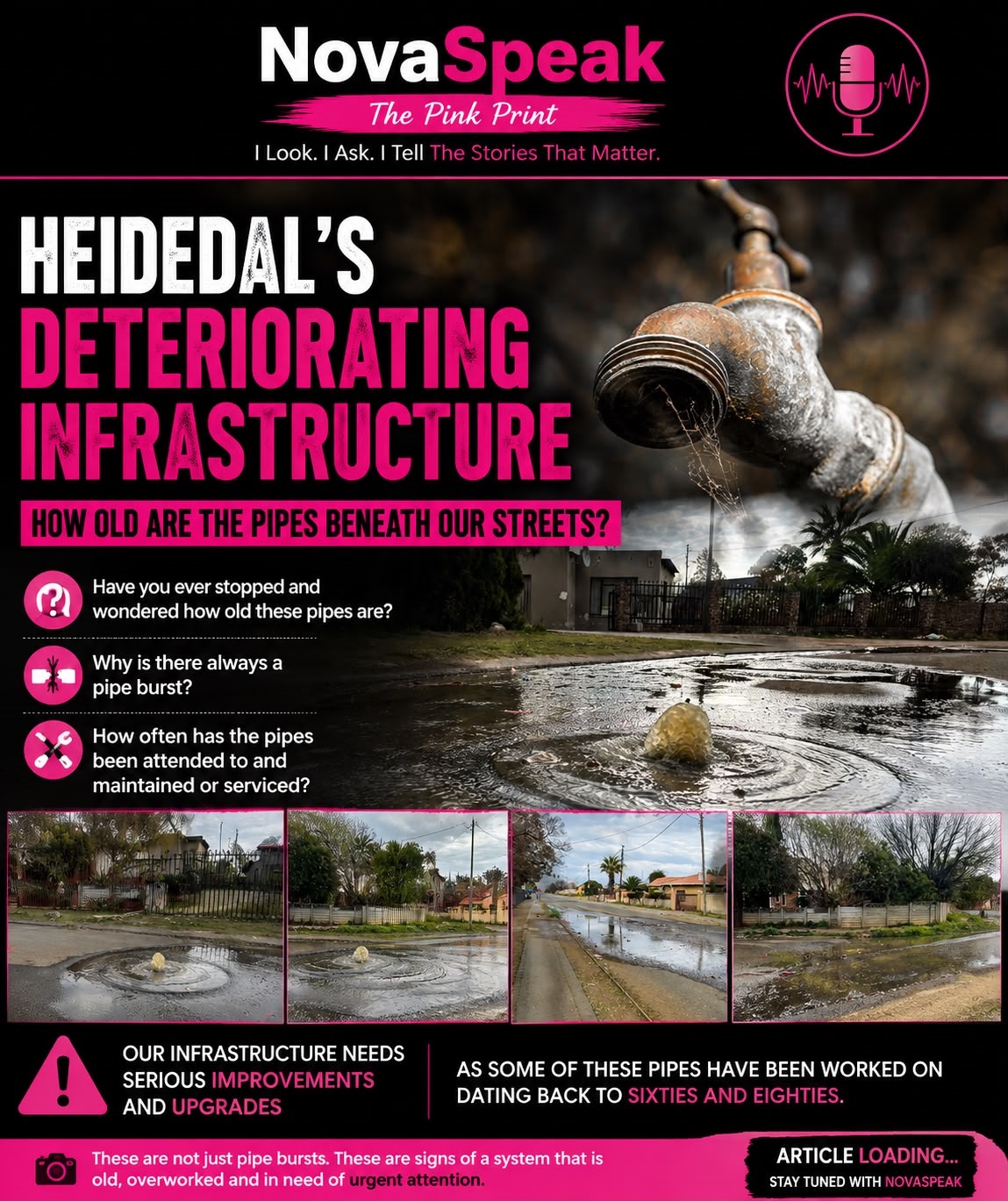
Have you ever stopped to wonder how old the water pipes beneath Heidedal’s streets actually are?
And more importantly: why do some areas seem to experience pipe bursts, maintenance interventions and water-related failures over and over again?
For residents, a burst pipe is more than water running down a street. It can mean interrupted water supply, damaged roads, traffic disruptions, wasted potable water and another repair bill for infrastructure that appears to be getting older by the day, but this week, that question has become more immediate.
What began as what was announced by Mangaung Metropolitan Municipality as a routine scheduled pipe repair on Monday, 17 August 2026, has left large parts of Heidedal without a reliable water supply for three days. Residents were given notice to prepare for the interruption. Proper communication and residents following the prescribed channels are important, but they do not change the bigger infrastructure question. When the water finally returns, some residents are reporting that it comes back brown or discoloured, only for another municipal notice to follow informing residents that further maintenance is being undertaken.
For communities, this creates a frustrating cycle:
Water interruption.
Maintenance.
Water returns.
Discoloured water.
Another notice.
Another maintenance intervention.
The issue is therefore no longer simply whether residents were warned.
The bigger question is:
Why does the same infrastructure continue to require repeated intervention and how sustainable is this approach?
THE AGEING INFRASTRUCTURE QUESTION
Mangaung’s own planning documents have previously acknowledged that the metro faces an ageing water infrastructure challenge. A Mangaung Metropolitan Municipality planning document stated that the municipality’s infrastructure was “very old” and had not been adequately maintained over an extended period, with maintenance expenditure falling below the norm cited in the document. The same document recorded thousands of water leakages requiring attention across the metro.
More recently, an infrastructure assessment undertaken for Mangaung identified a network containing approximately 3,906 kilometres of water pipes, alongside 2,615 kilometres of sewer pipes and 885 kilometres of stormwater infrastructure. The assessment specifically linked Mangaung’s ageing infrastructure to frequent burst pipes, leaks and water losses and highlighted the difficulty of planning replacements when there is insufficient information about the condition of problematic pipelines.
That raises a fundamental question for Heidedal:
What is the actual condition of the water network beneath the suburb?
REPAIR AFTER REPAIR — BUT WHERE IS THE LONG-TERM SOLUTION?
Mangaung’s own annual reporting has also acknowledged difficulties in its water maintenance programme.
The programme covers the repair of reticulation leaks and pipe bursts, but the municipality reported that it did not meet its target of attending to all complaints within 24 hours. It attributed the poor performance to factors including shortages of tools, equipment, budget and human resources.
That is significant.
Because if a pipe is repeatedly repaired but the underlying infrastructure remains old and vulnerable, residents are entitled to ask whether the municipality is spending money on reactive repairs instead of preventative replacement.
How many times has the same section of pipe been repaired?
How much has been spent on those repairs?
Was the pipe ever assessed for replacement?
And who decides when a pipe has reached the end of its useful life?
THE RECORDS QUESTION
NovaSpeak has also been asking a more basic question: what records exist to prove that this infrastructure has been consistently maintained over the years?
Records made available or referred to in the course of investigating the infrastructure history indicate that some municipal documentation relating to infrastructure and maintenance reaches back decades, with records dating to periods including the 1960s and 1980s.
However, this should not automatically be interpreted as proof that the specific water pipes currently serving Heidedal were installed during those decades.
That distinction matters.
The real concern is whether Mangaung Metro can produce a clear, up-to-date asset history showing:
* when individual water pipelines were installed;
* what materials were used;
* when they were last inspected;
* how often they have been repaired;
* how many major failures have occurred;
* what their current condition is; and
* when they are scheduled for replacement.
If those records exist, residents should be able to understand the infrastructure history of their suburb.
If records are incomplete, another question follows:
How is the municipality accurately determining which infrastructure requires replacement before it fails?
HEIDEDAL HAS ALREADY EXPERIENCED WATER PRESSURE
This is not a new conversation for the suburb, in November 2024, Mangaung Metro listed Heidedal among areas affected by water rationing during widespread supply interruptions. The municipality said the city was experiencing water-supply problems for almost two weeks due to several challenges, including debris or siltation affecting treatment capacity and in April 2025, residents in Heidedal, Bloemside and Opkoms were again reported to have experienced prolonged water-supply problems and in 2026, Bloemfontein has continued to experience significant water disruptions, including incidents involving bulk infrastructure and mechanical failures.
The problem, therefore, cannot simply be viewed through the lens of one burst pipe or one maintenance operation.
The bigger issue is the resilience of the entire water network.
THE 1960s AND 1980s QUESTION
Residents have raised concerns that some infrastructure in the area dates back decades, potentially as far back as the 1960s and 1980s.
NovaSpeak has not found sufficient publicly available documentation to independently confirm the installation dates of the specific Heidedal water pipes being discussed.
But the existence of decades-old municipal infrastructure records reinforces the need for transparency around the current condition and maintenance history of the network and there is another local infrastructure warning that residents will remember. The power plant failure/explosion associated with ageing infrastructure remains a reminder of what can happen when critical infrastructure reaches a point where maintenance, rehabilitation and replacement become unavoidable questions.
The comparison should not be taken to mean that Heidedal’s water pipes face the same risk or that the causes are identical.
Rather, it raises a broader principle:
Critical infrastructure cannot be maintained indefinitely through reactive intervention alone.
Eventually, ageing infrastructure requires proper assessment, capital investment, rehabilitation and replacement.
MAINTENANCE OR REPLACEMENT?
There is an important difference between maintaining an ageing system and continuously patching one that has reached the end of its useful life.
In 2025, the Department of Water and Sanitation handed over the completed first phase of the Welbedacht Pipeline project, a project costing approximately R595.7 million.
The project replaced ageing concrete water infrastructure with steel pipes along a 33.7-kilometre section supplying Mangaung. Government specifically said the ageing infrastructure had caused disruptions through frequent bursts and leaks.
The lesson is clear:
Ageing infrastructure eventually requires capital investment and replacement, not endless emergency repairs.
The question for Heidedal is whether the same principle is being applied to its local distribution network.
NOVASPEAK’S QUESTIONS TO MANGAUNG METRO
NovaSpeak is putting the following questions to Mangaung Metropolitan Municipality: " THAT IF THIS TIME THERE WILL BE AN ANSWER "
1. How old are the main water pipes serving Heidedal, and when were they originally installed?
2. Which sections of Heidedal’s water network are classified as ageing, high-risk or requiring replacement?
3. How many pipe bursts and water leaks have been recorded in Heidedal over the past five years?
4. How many times have the same pipeline sections been repaired during that period?
5. How much has Mangaung Metro spent on repairing water leaks and burst pipes in Heidedal over the past five years?
6. What is the average response time to a reported burst pipe in Heidedal?
7. How many water infrastructure maintenance complaints from Heidedal were not attended to within the municipality’s prescribed timeframe?
8. Does Mangaung have a preventative maintenance programme specifically targeting ageing water infrastructure in Heidedal?
9. What percentage of the Heidedal water network has been assessed for replacement or rehabilitation?
10. Does the municipality have a replacement schedule for ageing pipes in Heidedal, and what budget has been allocated to that work?
11. What specific work was scheduled to take place in Heidedal from 17 August 2026, and why did the interruption extend beyond the initially communicated period?
12. Why did residents experience brown or discoloured water when supply returned?
13. What additional maintenance was announced after the initial scheduled repair, and why was it necessary?
14. How many separate maintenance interventions have been carried out on the affected Heidedal network during the past five years?
15. Can Mangaung provide the relevant maintenance and asset records showing the inspection, repair and replacement history of the affected pipelines?
16. Does the municipality have records showing the original installation dates of the affected pipes?
17. If some infrastructure records date back to the 1960s and 1980s, what steps has the municipality taken to determine whether any remaining infrastructure from those periods is still in service?
18. Has Mangaung conducted a condition assessment of the affected Heidedal water network? If so, when was it conducted and what were the findings?
19. What is the municipality’s long-term plan to prevent recurring failures on ageing water infrastructure in Heidedal?
20. How much funding has been allocated specifically for the rehabilitation or replacement of Heidedal’s ageing water infrastructure in the current financial year?
THE BOTTOM LINE
Water infrastructure is largely invisible, until it fails, residents do not necessarily know what is happening beneath the roads they drive on every day.
They see the consequences:
Water flowing down streets.
Excavations.
Repaired roads.
Low pressure.
Brown water.
Interrupted supply.
And another maintenance notice.
But behind every burst pipe and every prolonged interruption is a bigger question about planning, maintenance, investment and accountability, Mangaung has already acknowledged the broader challenge of ageing infrastructure and now Heidedal residents deserve to know:
How old are our pipes?
How often are they being maintained?
How many times have they been repaired?
What condition are they actually in?
And when will the municipality stop repeatedly repairing yesterday’s infrastructure and start building tomorrow’s water network?
This is not simply about a pipe, it is about the infrastructure beneath an entire community and whether it is being maintained before it fails, rather than only after residents are left without water, because this week’s disruption may eventually end, the water may eventually return but unless the underlying infrastructure problem is addressed, residents have every reason to ask:
When will the next interruption come?
And how many more repairs will it take before replacement becomes the solution?
NovaSpeak: The Pink Print
I Look. I Ask. I Tell The Stories That Matter.