Opinion
HOW MANY MORE PROMISES CAN HEIDEDAL AFFORD?
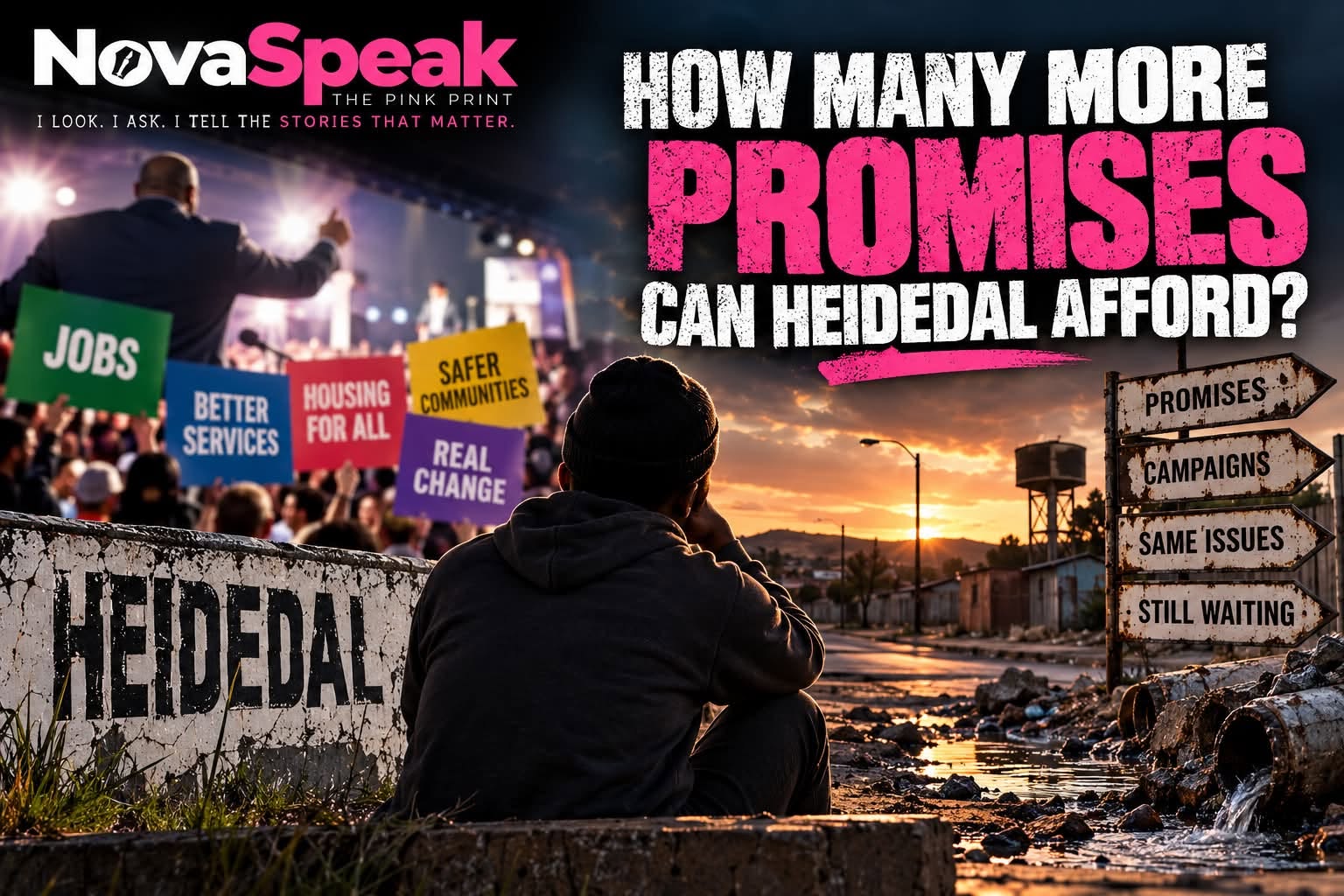
Political parties are asking Heidedal for another chance to govern, but before residents listen to a new round of promises, there is a more important question they should be asking: what happened to the promises already made — and who was held accountable when they were not delivered?
That question sits at the heart of the 2026 Local Government Elections as parties roll out manifestos promising better services, safer communities, housing, jobs, infrastructure and economic opportunities.
The latest promises arrived in Bloemfontein on Saturday, when the Patriotic Alliance launched its national local-government manifesto at Dr Petrus Molemela Stadium, with party president Gayton McKenzie outlining proposals around housing, municipal debt, rates relief, municipal land, neighbourhood-watch support, free Wi-Fi and basic service delivery.
But for Heidedal, the political question is no longer simply what parties say they will do if given power.
It is whether residents have any reason to believe those promises will survive beyond election day.
Because accountability cannot begin when the campaign starts.
It must begin with the record.
Heidedal residents do not experience government through manifestos or campaign speeches. They experience it through the tap that runs dry, the road that deteriorates, the sewage problem that remains unresolved, the public facility that is vandalised, the rubbish that accumulates and the young person who continues searching for work.
That is why every new promise should come with an old question:
What happened to the last one?
If a party promises improved water infrastructure, residents should be able to ask what happened to previous commitments, what has actually been delivered, what remains outstanding and who is responsible for the delays.
If housing is promised, residents should ask what happened to earlier housing commitments, where the land is, who qualifies, what process will be followed and when delivery is expected.
If jobs are promised, voters should ask how many opportunities were previously created, who benefited, what programmes worked and what will be done differently this time.
And if political parties promise support for neighbourhood watches or safer communities, residents should be entitled to ask what resources have already been provided, what results followed and who is accountable when safety commitments fail.
This is not about singling out one political party.
It is the standard that should apply to every candidate and every party asking Heidedal for a vote.
Because a manifesto is not an accountability mechanism.
A promise is not a performance report.
And an election victory is not a blank cheque.
Political parties can promise better roads, reliable water, safer communities, employment and improved infrastructure. But residents need more than assurances that change will come. They need commitments that can be measured, deadlines that can be tested and people who can be held responsible when those commitments are not met.
A campaign speech cannot repair a broken road.
A slogan cannot restore a failed water system.
And a promise of safer communities does not make a dangerous street safer.
The real measure comes afterwards.
That is why the PA's manifesto launch should be viewed as part of a much larger conversation taking place across Mangaung. Every political party now has an opportunity to tell residents what it believes it can change.
But voters have an equally important responsibility: to ask what evidence exists that those promises can become reality.
Heidedal has heard the language of change before.
Residents have organised around water problems, infrastructure concerns, crime, illegal dumping and the protection of public spaces because communities cannot simply wait indefinitely for solutions.
That civic involvement is valuable, but it should never become a substitute for government responsibility.
Residents should not have to repeatedly organise themselves to compensate for failures in the systems they already fund through rates, taxes and other municipal charges.
Nor should politicians rediscover communities only when votes are required.
Heidedal deserves engagement throughout the political term — and accountability throughout the political term.
That means the 2026 election should not simply ask which party has the most attractive manifesto.
It should ask which party is prepared to put its promises on the record and allow residents to measure its performance against them.
Campaign photographs are not evidence.
Speeches are not evidence.
Slogans are not evidence.
Promises are not evidence.
Results are evidence.
A repaired road is evidence.
A functioning water system is evidence.
A sewage problem permanently resolved is evidence.
A restored and protected public facility is evidence.
A genuine employment opportunity that moves someone from unemployment into work is evidence.
A measurable improvement in neighbourhood safety is evidence.
That is the standard Heidedal should demand from every candidate.
Not bigger promises.
Not louder rallies.
Not better campaign slogans.
Proof — and accountability when the proof is missing.
So perhaps the most important question of the 2026 election is not:
“What will you do for Heidedal?”
It is:
“What are you promising, what have you already delivered, when will the next commitment be fulfilled — and who takes responsibility if you fail?”
That is a question every political party should be prepared to answer before asking residents to place another X beside its name.
Because Heidedal has listened.
It has waited.
It has watched election seasons come and go.
Now residents have an opportunity to judge every promise against the only measure that ultimately matters:
what happens on the ground.
The community does not need politicians to promise change louder.
It needs them to deliver change visibly, measurably and accountably.
And perhaps after years of hearing what could happen, Heidedal is entitled to say:
Show us what happened. Tell us what comes next. Give us a deadline. And be prepared to answer when it does not happen.
NovaSpeak | The Pink Print
We Look. We Ask. We Tell The Stories That Matter.