Community
THE TRUCK DIDN’T COME — SO WHO ANSWERS?
Illegal dumping is wrong. But Mangaung’s refuse crisis raises a harder question: what happens when the municipality fails to collect?
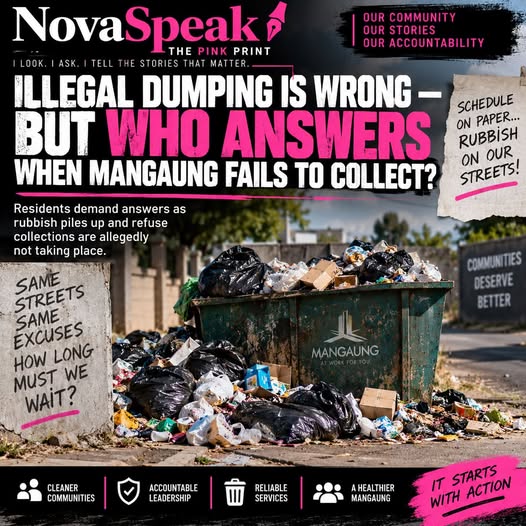
The rubbish does not disappear because Mangaung Metro Municipality publishes a collection schedule.
It remains in the bin. It remains outside the gate. It begins to smell. It attracts flies and other pests. It spills into the street. And eventually, in communities where collections are repeatedly missed, some of that waste can end up exactly where it should never be — on vacant land, open spaces and illegal dumping sites.
Illegal dumping is wrong. There is no debate about that.
But there is another question Mangaung cannot avoid: when the municipality fails to collect household refuse according to its own schedule, who answers for the consequences?
That question has resurfaced after Mangaung published an updated refuse collection schedule earlier this month, prompting residents to question whether another timetable will make any difference if the service on the ground does not match the promise on paper.
One resident put the frustration bluntly: “But you don’t adhere to the same schedule you drafted, what’s the use?”
Another claimed their area had been skipped on its scheduled collection day, saying: “Will the nice table actually help them pick up the refuse? We were skipped over on Monday, and now only half of the promised area was removed today.”
Those complaints expose the uncomfortable space between service promised and service delivered.
A collection schedule is supposed to create certainty. Residents organise their household waste around it. They know when to put their bins out and when they can reasonably expect them to be emptied.
But when the truck does not arrive, certainty disappears.
The waste stays.
Then the next collection day arrives.
If that collection is missed too, the problem grows.
And when households have nowhere practical to store accumulating waste, the pressure eventually moves beyond the property line and into the community.
This does not excuse illegal dumping. Residents have a responsibility to dispose of waste legally and responsibly.
But municipal accountability does not disappear simply because illegal dumping exists.
In fact, the two problems may be connected.
Democratic Alliance ward councillor Athur Terblanche said missed collections are a recurring problem in communities and can contribute directly to illegal dumping.
“In most of the communities, illegal dumping is a major issue. The refuse does not get collected on time. There is always a challenge, sometimes it’s the trucks that break down or there is no diesel, which results in residents dumping their refuse anywhere,” Terblanche said.
If that account is accurate, then the issue is no longer simply about residents breaking municipal by-laws.
It becomes a question about fleet management, fuel availability, operational planning and accountability inside the municipality itself.
Terblanche also alleged that some municipal workers do not always follow the published collection schedule, claiming that refuse is sometimes collected at night or over weekends.
Those allegations should not simply be accepted as fact — but neither should they be ignored.
They require the municipality to answer.
How many refuse trucks are currently operational?
How many are out of service?
How often are collection routes missed?
How much downtime is caused by vehicle breakdowns?
Are fuel shortages disrupting collection routes?
How many households are affected when a route is missed?
And when a scheduled collection does not take place, who is responsible for ensuring that the missed route is recovered?
These are not technical questions for residents to solve.
They are questions of municipal management.
Because the success of refuse collection cannot be measured by how many schedules are published. It must be measured by whether the waste is actually collected.
That distinction matters.
A municipality can publish a beautifully structured timetable, but if the truck does not arrive, the document has little value to the resident standing beside an overflowing bin.
And that is where the conversation about illegal dumping needs to become more honest.
Telling residents not to dump illegally is necessary.
But telling residents not to dump while failing to explain why scheduled collections are repeatedly missed is not enough.
Accountability must run in both directions.
Residents must answer for illegal dumping.
Municipal officials must answer for municipal service delivery.
Neither responsibility cancels the other.
The real danger is when the two are allowed to become substitutes for one another.
Residents cannot point to municipal failures and claim that dumping is therefore acceptable.
But the municipality cannot point to illegal dumping and use it to avoid answering questions about missed collections.
The rubbish on the ground may be the most visible part of the problem.
The less visible issue is what happened before it got there.
Was the truck unavailable?
Was there no diesel?
Was the route missed?
Was the workforce available?
Was the collection rescheduled?
Was anyone held accountable?
And, most importantly, did anyone tell residents what was happening?
That is the accountability gap Mangaung now needs to confront.
Because residents do not need another timetable that looks convincing on a municipal social-media post.
They need the truck to arrive.
They need the bin emptied.
They need the service they are entitled to receive.
And when that service fails, they need an explanation that goes beyond “the collection was missed”.
Mangaung’s waste crisis therefore demands more than another warning against illegal dumping.
It demands transparency about the machinery behind refuse collection — the trucks, the fuel, the routes, the workers, the missed collections and the consequences when the system breaks down.
Because a bin left uncollected for one day may be an inconvenience. A route repeatedly left uncollected becomes a service-delivery failure.
And when that failure contributes to rubbish spilling into public spaces, the question cannot simply be: Who dumped it?
The question must also be:
Who was supposed to collect it — and who answers when they didn’t?
NovaSpeak | The Pink Print
We Look. We Ask. We Tell The Stories That Matter.