Opinion
When Accountability Becomes “Sensation”: What Does That Say About Us?
Recently, NovaSpeak was described as “fake”, accused of producing “nonsense” and criticised for allegedly seeking “sensation”. Those words may have been directed at a media platform, but perhaps they should prompt a much bigger question — one that reaches beyond NovaSpeak itself.
What do those words say about us as a community?
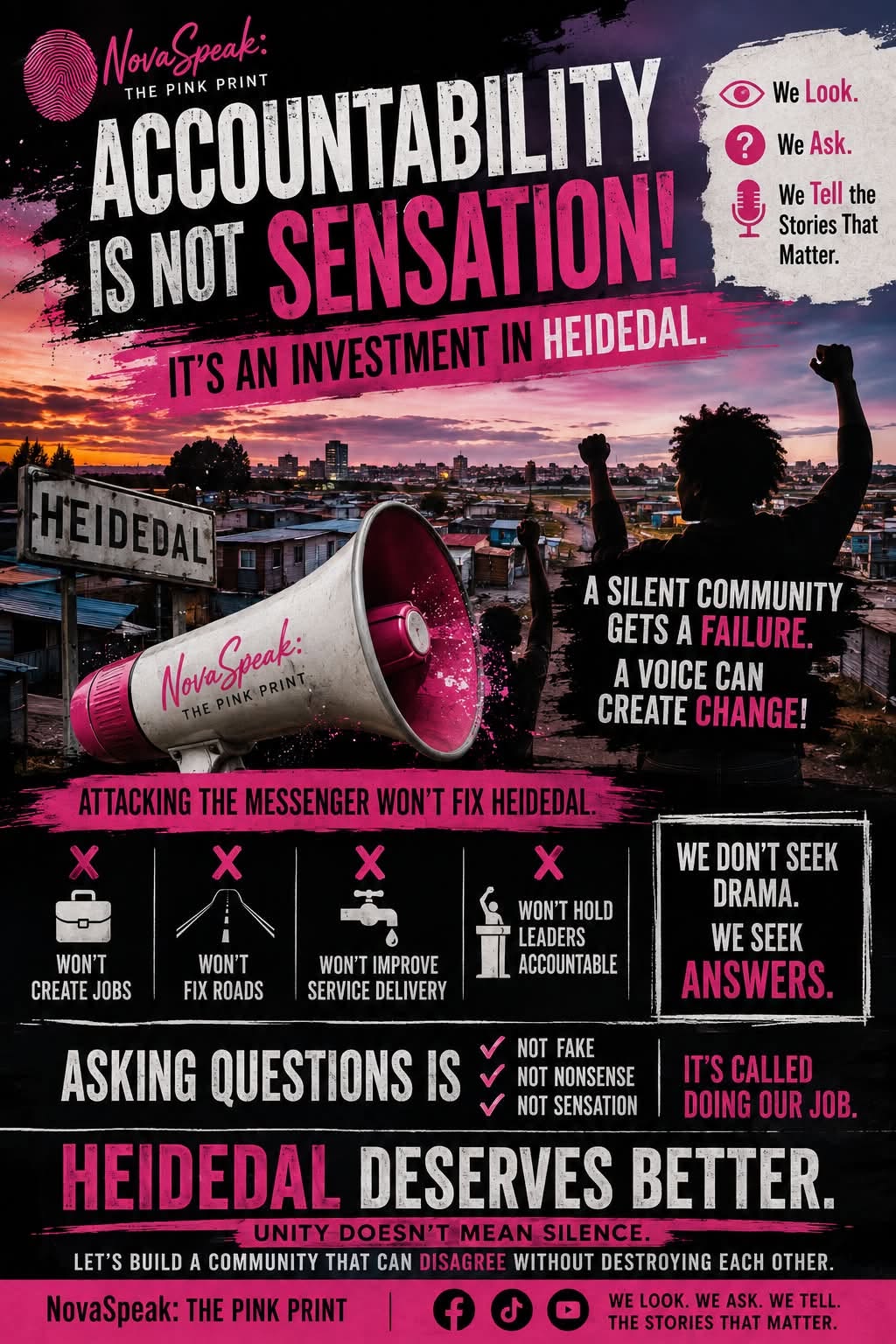
There is something deeply troubling about watching members of the same community turn against one another simply because someone dares to ask uncomfortable questions. Heidedal is a community that has survived hardship, neglect, political disappointment and generations of being told to wait. It is a community that speaks often about unity, standing together and uplifting one another, yet sometimes, when someone steps forward and says, “We need better,” the response is not support, debate or constructive criticism, but a personal attack on the person who dared to say it.
Recently, NovaSpeak was described as “fake”, accused of producing “nonsense” and criticised for allegedly seeking “sensation”. Those words may have been directed at a media platform, but perhaps they should prompt a much bigger question — one that reaches beyond NovaSpeak itself.
What do those words say about us as a community?
What happens when a fellow member of Heidedal raises questions about the community and, instead of engaging with those questions, we attack the person asking them? What happens when disagreement becomes personal before the facts are even discussed? And what does that say about the kind of community we are trying to build?
Are we really standing together if unity only exists when everyone agrees? Are we really uplifting one another if challenging the status quo immediately becomes grounds for hostility? And can we honestly demand change if uncomfortable questions are dismissed simply because they make someone uneasy?
These are difficult questions, but perhaps that is precisely why they need to be asked.
NovaSpeak does not claim to be perfect. It does not claim to know everything, nor does it suggest that every story will satisfy every reader. Journalism is not about pretending to have all the answers. It is about asking questions, examining information, listening to people and bringing issues that affect the public into the open.
That responsibility includes the good.
Heidedal has remarkable people. There are residents making a difference, young people pursuing opportunities, businesses creating livelihoods, community organisations doing important work and ordinary people quietly contributing to the wellbeing of others. Those stories deserve to be told, and NovaSpeak will continue telling them.
But telling the good stories cannot mean deliberately avoiding the difficult ones.
A community publication cannot celebrate achievements while looking away from service-delivery failures. It cannot highlight community events while ignoring residents' frustrations. It cannot report political promises without asking whether those promises were fulfilled. And it cannot claim to serve the community while avoiding the questions that matter most to the people living here.
Because journalism that only celebrates is not journalism.
Sometimes the story is supposed to make you uncomfortable.
Sometimes the question is supposed to be difficult.
And sometimes the people being questioned will not appreciate being questioned.
That is not necessarily a failure of journalism. It can be evidence that the journalism is doing what it is supposed to do.
None of this means NovaSpeak should be above scrutiny. Quite the opposite.
If a story is inaccurate, challenge the facts. If context has been missed, provide it. If another perspective deserves to be heard, bring it forward. If NovaSpeak gets something wrong, it should be corrected.
That is a healthy public conversation.
But there is a difference between challenging journalism and attacking the people behind it. Calling something “nonsense” does not disprove it. Calling a platform “fake” does not make the underlying questions disappear. And accusing someone of seeking “sensation” does not answer the issue being raised.
The question remains.
That distinction matters because Heidedal already has enough challenges without residents turning against one another. There are concerns about employment, infrastructure, service delivery, development, safety and opportunities for young people. None of those problems will be solved by Facebook arguments or personal insults.
An insult will not create a job.
A social-media argument will not repair a road.
Calling someone fake will not improve municipal services.
And protecting personalities will never be more important than protecting the interests of the community.
That is why asking difficult questions should not be treated as an attack on Heidedal.
It is possible to love your community and still criticise it. In fact, sometimes criticism comes precisely because you care enough to believe that things can be better.
You question a decision because you believe residents deserve an explanation. You challenge leadership because you believe people deserve better. You investigate a problem because accepting it as normal is not good enough.
That is not betrayal.
It is participation.
And perhaps this is where we need to rethink what unity actually means.
Standing together does not mean agreeing on everything. It does not mean protecting individuals, political parties or organisations from criticism. It means being able to disagree without destroying one another and keeping the interests of the wider community above personal loyalties.
A strong community should be able to withstand difficult questions.
It should be able to debate.
It should be able to correct mistakes.
And it should be able to demand better without turning on the people who ask why better has not yet arrived.
NovaSpeak will not always get everything right. But if something is wrong, challenge it. If something is unfair, explain why. If facts have been missed, bring them forward. If another side deserves to be heard, let that side be heard.
That is how journalism becomes stronger.
And it is how communities become stronger too.
Heidedal has spent generations asking for better — better opportunities, better infrastructure, better services, better representation and better leadership.
It would be deeply contradictory to demand those things while attacking anyone who asks why they have not been delivered.
Ultimately, this is not about whether NovaSpeak is “fake”. It is not about whether one story made somebody angry. It is not about which political party someone supports.
It is about whether Heidedal is prepared to have honest conversations about itself.
Are we prepared to acknowledge what is working while confronting what is not? Can we celebrate our successes without becoming blind to our failures? Can we question those in positions of responsibility without turning every question into a political fight?
And, perhaps most importantly, can we understand that loving your community sometimes means refusing to remain silent about the things that are hurting it?
Communities do not change through silence. They change when people begin asking why.
Why has this not been fixed?
Why was that promised?
Who is responsible?
When will it be delivered?
What happens next?
Those questions are not sensational simply because they are uncomfortable.
They are part of a functioning community.
NovaSpeak will celebrate Heidedal when there is something to celebrate. We will tell the stories of residents doing extraordinary things in ordinary circumstances. We will listen to voices that are often overlooked, question what needs questioning and seek answers where answers are needed.
But we will not apologise for asking legitimate questions simply because someone does not like them.
We will not confuse criticism with hatred, disagreement with division, or uncomfortable journalism with sensationalism.
And we will not confuse standing together with standing silently.
Because this platform was never created to make everyone comfortable.
It was created to look closer, ask harder and tell the stories that matter.
At the centre of that responsibility is not NovaSpeak.
It is Heidedal.
And if we genuinely want a better Heidedal, perhaps the conversation should no longer be about whether those who ask difficult questions are causing division.
Perhaps we should ask ourselves why those questions make us uncomfortable in the first place.
Because sometimes the most uncomfortable question is also the most important one:
Are we really standing together if standing together means nobody is allowed to speak up?
NovaSpeak | The Pink Print
We Look. We Ask. We Tell The Stories That Matter.