Community
ACROSS THE ROAD FROM DIGNITY: THEY WAKE UP TO THE FLATS THEY CANNOT AFFORD
Seven Households. One Toilet. No Water. No Electricity — Across the Road from Dark and Silver City
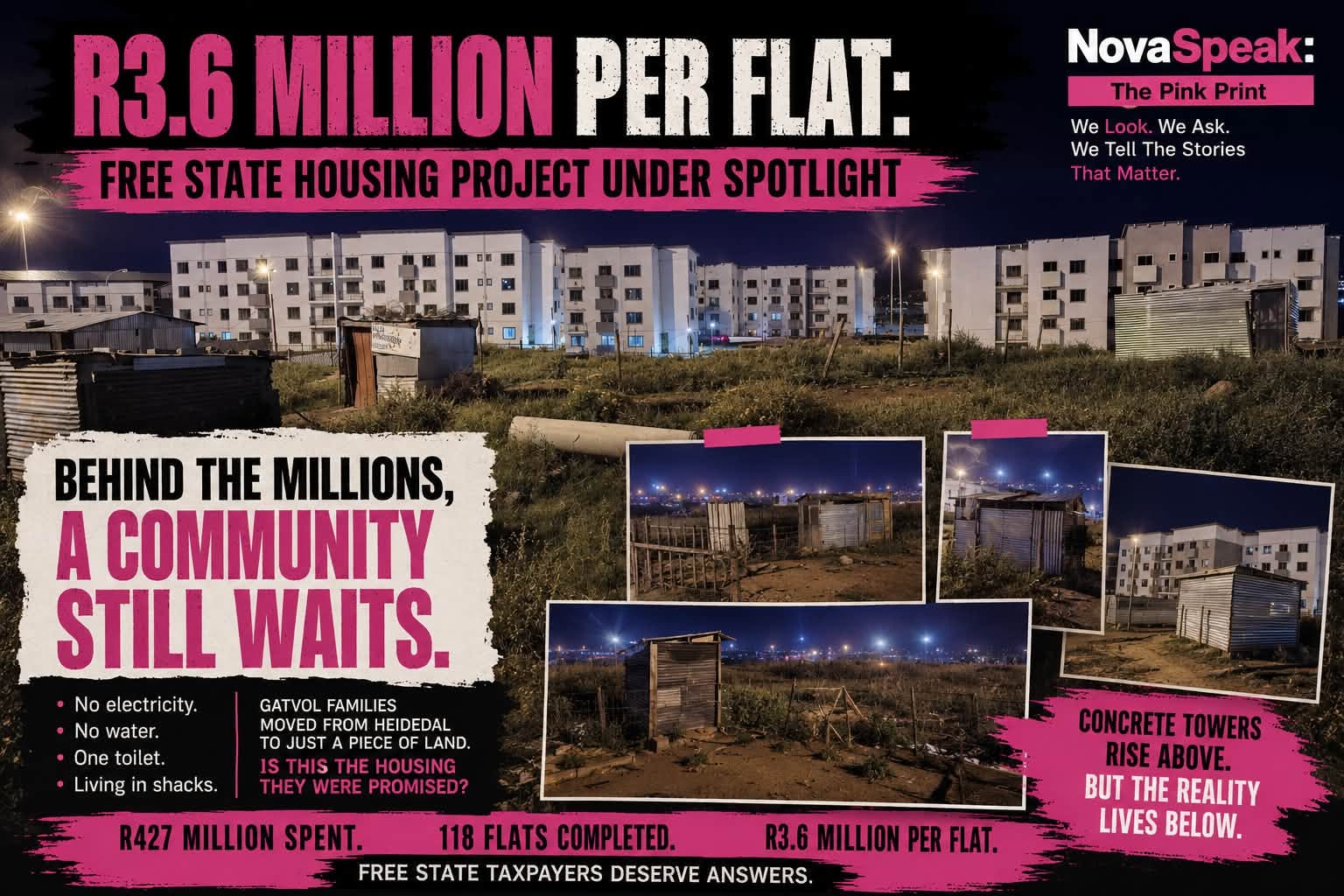
The concrete towers of Dark and Silver City rise above Bochabela, visible across the Bloemfontein skyline. From a distance, they look like the promise of a new beginning — modern apartments, formal housing and the possibility of dignity for families who have spent years waiting for a better place to call home.
But look directly across the road and that promise takes on a very different meaning.
There, an estimated seven households live in corrugated-iron structures surrounded by makeshift fencing, vacant and overgrown land and rudimentary shelters. Residents face some of the most basic challenges imaginable: one toilet, no water and no electricity.
And every morning, they wake up to the same view.
Modern flats.
Formal homes.
Electricity.
Infrastructure.
The very things they need, but cannot afford to access.
That is the uncomfortable contradiction at the heart of Dark and Silver City — and perhaps one of the clearest images yet of the Free State's housing crisis.
The buildings are not somewhere far away. They are not hidden behind a distant horizon. They are metres from families still living in conditions that appear worlds apart from the development rising beside them.
They can see the homes. They simply cannot afford to live in them.
And that is where this story becomes bigger than construction, contracts and concrete.
It becomes a story about access.
It becomes a story about affordability.
And ultimately, it becomes a story about whether government housing is reaching the people it was intended to serve.
A recent Sunday Times investigation reported that approximately R427 million has been spent on the Dark and Silver City bottom-site development, with only 118 flats ready for occupation. Based on those reported figures, the expenditure works out to roughly R3.6 million for every completed flat, despite an original planned cost of approximately R233,000 per unit. The development was initially intended to deliver 526 units across 19 high-rise apartment blocks.
Those figures are difficult to ignore.
But for the people living across the road, the calculation is different.
They are not calculating the cost of a completed apartment.
They are calculating how to get through another day without reliable basic services.
They are not studying construction contracts.
They are looking at one toilet serving several households.
They are not asking how many millions have been spent on the development.
They are asking where their next supply of water will come from.
And they are not looking at the apartment blocks simply as buildings.
They are looking at them as a daily reminder of a life they can see but cannot afford.
The history of Dark and Silver City makes the contrast even more difficult to understand.
The project dates back to 2014, when Ruwacon Construction was appointed for R123.6 million, with an 18-month completion period. Its contract was terminated in 2017. Uniq Holdings was subsequently appointed for R79.5 million and, according to the investigation, was eventually paid R98.2 million before its contract was also terminated. Ruwacon was later brought back to the project and received a further R78.5 million under another contract reportedly valued at R63 million.
What was supposed to be an 18-month housing project became a saga stretching across more than a decade.
Contractual problems, contractor changes, vandalism, community disruptions and escalating costs became part of the project's story. The Free State government's March 2026 update acknowledged these difficulties and noted that construction had extended far beyond the original completion period. It also acknowledged that money had been spent on site establishment without necessarily producing actual construction work.
That history raises an obvious public-interest question: how does a project designed to provide affordable housing become a multimillion-rand exercise in delay and escalation?
But perhaps an even more important question is what all that expenditure means for the families who remain outside the development.
Because housing is not ultimately about buildings.
It is about people.
It is about households being able to live safely.
It is about children having a secure place to sleep.
It is about parents having access to water and electricity.
It is about families having sanitation that does not compromise their dignity.
And it is about whether the person who desperately needs housing can actually afford the accommodation being provided.
Dark and Silver City is intended to provide Community Residential Units aimed at low-income households. Government procurement documentation describes the CRU model as targeting people earning less than R3,500 a month, with rental structured around affordability and cost recovery rather than ordinary market conditions.
But affordability cannot simply be a classification on a government document.
Affordability is experienced at the kitchen table.
It is experienced by the pensioner working out what remains after rent.
It is experienced by an unemployed parent trying to stretch a social grant across an entire month.
It is experienced by a single parent who must consider rent alongside electricity, transport, food, school expenses and other household costs.
For someone living on a SASSA grant, qualifying for accommodation does not automatically mean being able to sustain the cost of living inside that accommodation.
That is why the questions surrounding Dark and Silver City are so important.
What does formal rental accommodation mean to an elderly person surviving on a social grant?
What happens to a household with no formal employment?
What happens to a family whose income is already insufficient to cover basic necessities?
And what happens when a household qualifies for a formal unit but cannot afford all the costs associated with living there?
These are not theoretical questions.
The tenanting process has already begun.
In March 2026, the provincial government reported that a Facility Management Company had been appointed to assist with tenanting and that 100 Bottom Site units and 30 Top Site units had been completed at that stage. The province's 2026 State of the Province Address said the first phase had been completed and was due to open in March.
By August, OFM reported that tenanting had begun, with 98 tenants approved and 19 already occupying their units, while other approved tenants were still being processed.
That means the conversation has now moved beyond whether the buildings are being completed.
The question is who gets access to them.
Who gets the keys?
And, perhaps more importantly:
Who remains outside?
For the families living across the road, that distinction is everything.
Because a person can live metres away from a formal housing development and still remain excluded from it.
The flats can stand within sight of their front doors while the basic necessities of water, electricity and sanitation remain out of reach.
That is the contradiction captured by this image.
And it is a contradiction that becomes even more significant when considered alongside the housing struggles in nearby Heidedal.
Gatvol became a symbol of desperation over access to housing, with families occupying vacant land because they needed somewhere to live. Earlier reporting documented serious challenges involving sanitation, sewage and access to basic services, while Mangaung's planning documentation has continued to identify the area among communities requiring relocation.
But relocation raises another question:
Relocated to what?
Moving a family from an informal settlement to another piece of land does not automatically mean that family has been given a home.
A serviced stand is not the same as a completed house.
A piece of land does not automatically provide shelter, electricity, water, sanitation or security.
For families affected by relocation, the question therefore becomes whether the process provides a genuine pathway towards dignified housing or simply moves the problem from one location to another.
This is why Dark and Silver City cannot be judged only by the appearance of its buildings.
From a distance, the development looks impressive.
Up close, the questions become harder.
The apartment blocks represent government investment and years of planning.
The shacks represent people still waiting for the benefits of that investment.
The buildings have walls, windows, balconies and electricity.
Across the road, families are trying to live without the most basic services.
And the financial story makes the contrast even more difficult to dismiss.
The Sunday Times investigation reported that three Free State housing projects have consumed approximately R1.2 billion over 12 years, amid delays, failed contractors, vandalism and escalating costs. The Hawks have reportedly opened a criminal investigation linked to the projects, while disciplinary proceedings against officials are reportedly under way. The Auditor-General's office reportedly opened a criminal case in August 2023.
These reports do not establish criminal wrongdoing by everyone involved, and allegations must be tested through evidence and due process.
But the existence of investigations does not remove the public's right to ask questions about the expenditure.
In fact, it makes transparency even more important.
Public money creates a public obligation.
Public housing creates an even greater obligation because the ultimate beneficiaries are supposed to be people whose circumstances make decent housing difficult to secure through the private market.
President Cyril Ramaphosa, Human Settlements Minister Thembi Simelane and Free State Premier MaQueen Letsoha-Mathae visited Dark and Silver City in March as government sought to accelerate delivery of the long-delayed development.
But a government visit cannot answer the question that matters most to the people living across the road.
Where is our home?
If these flats are intended for qualifying low-income households, residents deserve to know exactly how the system works.
How are tenants selected?
What will they pay?
How many people from surrounding informal settlements qualify?
How many households dependent on SASSA grants qualify?
How many applications have been approved?
How many have been rejected?
And how many families living around Dark and Silver City have actually been integrated into the formal housing programme?
These questions should not be interpreted as an attack on government.
They are questions of accountability.
Because a housing project cannot be considered successful simply because the concrete is standing.
Success must ultimately be measured by people.
Can they afford to live there?
Can they access water?
Do they have electricity?
Does the sanitation work?
Can children live safely?
Can families remain there without being pushed back into poverty by the cost of accommodation?
And, critically, are the people living in the surrounding informal settlement being given a realistic pathway into formal housing?
The seven households living across the road bring these questions into sharp focus.
One toilet.
No water.
No electricity.
Modern flats metres away.
A daily view of a development that represents the formal housing they need, but cannot afford to sustain.
That is why this is not simply a story about a construction project.
It is a story about the distance between building housing and providing homes.
Those two things are not always the same.
A building can be completed while a family remains homeless.
A housing project can be officially opened while people nearby continue without basic services.
A tenant can receive a key while another household remains outside the gate.
And a development can look like progress from the road while the people living across that road continue asking when their turn will come.
That is the uncomfortable reality Dark and Silver City now presents.
The buildings are there.
The lights are on.
The balconies are visible.
The formal housing exists.
But across the road, families are still living with the absence of the basics.
They wake up in the morning and see the flats.
They see the infrastructure.
They see the lights.
They see what dignity could look like.
Then they return to homes without electricity, without water and with one toilet shared among an estimated seven households.
The contrast is not subtle.
It is right there.
It is visible.
And it raises a question that cannot be answered by another progress report.
Who was this housing built for?
The Free State government now has an opportunity to provide the answers residents and taxpayers deserve: how much has ultimately been spent on Dark and Silver City, how much more will be required, how many units are genuinely complete and habitable, how many are occupied, how tenants are selected, what they pay, how many applicants have been approved or rejected, and how many households from surrounding informal settlements have been successfully integrated into the formal housing programme.
Most importantly, government needs to explain how it intends to ensure that housing reaches the people who need it most — not merely those who can afford to sustain the accommodation once they receive it.
Dark and Silver City has become more than a housing development.
It has become a test of whether government can turn public money into public value.
It is a test of whether affordable housing is genuinely affordable.
It is a test of whether relocation leads to dignity rather than displacement.
And it is a test of whether the families standing outside the buildings will ever be given the opportunity to walk through their doors.
Because from across the road, the flats may look like progress.
But for the families living in shacks, they may also represent something much more painful: a daily view of the home they need, but cannot afford.
And perhaps that is the real story behind the photograph.
Not simply that modern flats stand beside informal structures.
Not simply that millions have been spent.
But that people can stand within sight of formal housing and still go to sleep without water, electricity or adequate sanitation.
They wake up every morning looking across the road at dignity.
They just cannot afford to cross into it.
NovaSpeak: The Pink Print
We Look. We Ask. We Tell The Stories That Matter.