Politics
Is This Really a Good Look for Heidedal? PA vs VF+ Puts Leadership Under the Microscope
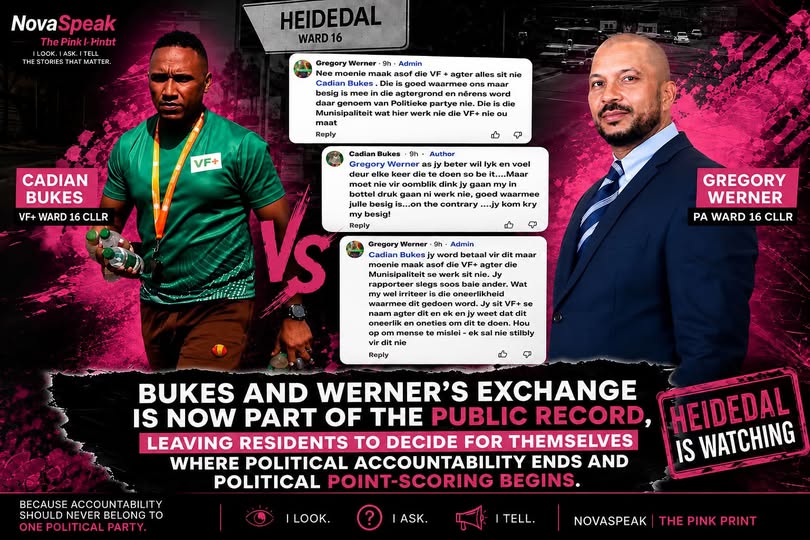
A Facebook exchange between Patriotic Alliance (PA) councillor Gregory Werner and VF Plus councillor Cadian Bukes has exposed tensions over municipal service delivery, political credit and the way councillors communicate their work to residents. What began as a disagreement over how municipal work in Heidedal is presented quickly became something bigger — a public contest over credibility, responsibility and political ownership.
I Look. I Ask. I Tell The Stories That Matter.
A political exchange between two Ward 16 councillors has once again pushed an uncomfortable question into the spotlight: when political representatives publicly fight over who is doing the work, who ultimately benefits — the politicians, or the community they represent?
A Facebook exchange between Patriotic Alliance (PA) councillor Gregory Werner and VF Plus councillor Cadian Bukes has exposed tensions over municipal service delivery, political credit and the way councillors communicate their work to residents. What began as a disagreement over how municipal work in Heidedal is presented quickly became something bigger — a public contest over credibility, responsibility and political ownership.
Werner challenged what he described as an attempt to create the impression that the VF Plus was behind municipal work being carried out in the area, arguing that municipal work belongs to the municipality and should not be presented as the work of a political party. Bukes responded that Werner was welcome to scrutinise his work, insisting that criticism would not stop him from getting involved in matters affecting the community. Werner then doubled down, accusing Bukes of highlighting only certain aspects of the work and questioning what he described as the use of the VF Plus name alongside municipal achievements.
The exchange is now part of the public record, leaving residents to decide for themselves where political accountability ends and political point-scoring begins.
And that is precisely where the bigger issue starts.
Political disagreement is not inherently a bad thing. In a functioning democracy, councillors should challenge one another, question municipal decisions and hold government accountable. Residents should expect their elected representatives to disagree when they believe something is wrong.
But there is an important difference between robust political debate and making serious allegations without evidence.
Once claims of wrongdoing, dishonesty or criminal conduct enter the political arena, the standard must change. Such allegations cannot simply be tried on Facebook, repeated in community conversations and presented as established fact without credible evidence to support them.
If a political representative genuinely possesses information pointing to possible criminal conduct, corruption or other serious wrongdoing, there are proper channels available. The matter should be reported to the South African Police Service or the relevant oversight or investigative authority, where evidence can be assessed and a proper investigation can take place.
Social media cannot replace due process, and political opponents should not be turned into defendants in a court of public opinion simply because an allegation has been made. Public office is not a platform for speculation. It carries a responsibility to act lawfully, responsibly and in the public interest.
That responsibility becomes even more important when political leaders make serious claims in public. South Africans have become increasingly accustomed to a political culture where allegations travel faster than evidence, where social media posts become political ammunition and where supporters are expected to choose sides before the facts have even been established.
That is not the standard of leadership communities should accept.
Political representatives have a responsibility to understand the weight of their words, particularly when those words can damage reputations, deepen political divisions or create the impression that allegations are facts.
For Heidedal, however, there is an even more immediate concern.
Residents are not simply watching two political parties argue online; they are watching the people elected to represent them. They want potholes repaired, infrastructure maintained, municipal services delivered and complaints followed up. They want councillors who will knock on doors, make calls, submit complaints, demand answers and continue pushing until something changes.
And when work is finally done, residents deserve an honest explanation of what the municipality did, what political representatives did to facilitate or demand the work, and where credit properly belongs.
That is why the PA versus VF Plus dispute should not simply be dismissed as another political squabble. It provides a glimpse into the type of political culture residents are being asked to accept.
If councillors spend more time fighting over political ownership than explaining the problems facing the community, residents are entitled to ask whether their interests are really coming first.
The political colours may be different, but the responsibility is ultimately the same: represent the people.
So the uncomfortable question becomes: Is this really a good look for Heidedal?
A community should not have to watch its political representatives publicly tear each other down while the issues affecting residents remain bigger than the personalities involved.
Political competition is inevitable, particularly with elections approaching, but competition should be about who can deliver better representation, stronger oversight and more effective service delivery — not who can win the loudest argument online.
There is also nothing wrong with a councillor taking pride in work they helped facilitate. In fact, residents should know which representatives are active and which ones are not. But political communication becomes problematic when the line between reporting one’s involvement and claiming ownership of government responsibility becomes blurred.
If the municipality is responsible for a service, that should be acknowledged. If a councillor pushed for the work, followed it up or brought residents’ concerns to the municipality, that contribution should also be acknowledged.
Accountability means giving the public the complete picture, not simply the version that benefits a political party.
The same principle applies to allegations.
If there is evidence, present it. If there is wrongdoing, report it. If there is a failure, document it. If a councillor is responsible for something positive, give credit. And if a political opponent has genuinely contributed to solving a community problem, acknowledging that contribution does not make one weak — it demonstrates leadership.
Heidedal deserves politicians who understand that their first responsibility is not to their party’s Facebook page, political branding or next election campaign.
Their first responsibility is to the people who live in the community they represent.
Those residents deserve evidence instead of speculation, accountability instead of political theatre, and solutions instead of endless political battles.
The real question, then, is not who won the argument between the PA and VF Plus?
It is much more important than that.
Did Heidedal win?
Because political parties will change, councillors will change and election campaigns will eventually end.
But Heidedal will remain.
And the people who live there will still have to live with the consequences of the leadership they choose.
NovaSpeak | The Pink Print
I Look. I Ask. I Tell The Stories That Matter.